

One missing piece of medical history can dramatically alter the outcome of a case. Whether you’re handling workers’ compensation claims, personal injury litigation, or insurance disputes, the difference between a complete and incomplete medical record can mean thousands of dollars and months of delays.
Consider this scenario: A claimant files for workers’ compensation benefits for a back injury sustained on the job. Initial medical records show a recent injury with clear diagnostic imaging. However, comprehensive medical record canvassing reveals treatment for the same condition at three different facilities over the past five years, including previous MRIs showing degenerative changes.
This isn’t an isolated incident. ISG data shows that 90% of comprehensive medical canvasses reveal additional records that weren’t initially disclosed or discovered through standard record requests. These findings can be game-changing for claims outcomes.
Why Standard Record Requests Fall Short
Traditional record retrieval methods often rely on claimant-provided information or basic searches of obvious providers. This approach creates significant blind spots that can compromise the accuracy and completeness of medical histories. Memory gaps represent a common challenge, as claimants may genuinely forget treatments from years past, particularly routine visits or procedures that seemed minor at the time but may be medically significant.
The complexity of multiple provider networks in modern healthcare compounds this issue, as patients typically receive care from numerous specialists, urgent care centers, and hospital systems that may not be connected through shared electronic health records. Geographic mobility adds another layer of complexity, since individuals frequently move and receive care across different regions, creating scattered medical records that are difficult to track through conventional methods.
Emergency care presents a particular blind spot, as urgent and emergency treatments may not be on a claimant’s mental radar when providing their medical history, yet these visits often contain crucial diagnostic information. Additionally, family practice changes occur frequently due to insurance changes, relocation, or practice closures, meaning that significant portions of a patient’s primary care history may be housed with providers who are no longer their current healthcare team and thus not mentioned in standard record requests.
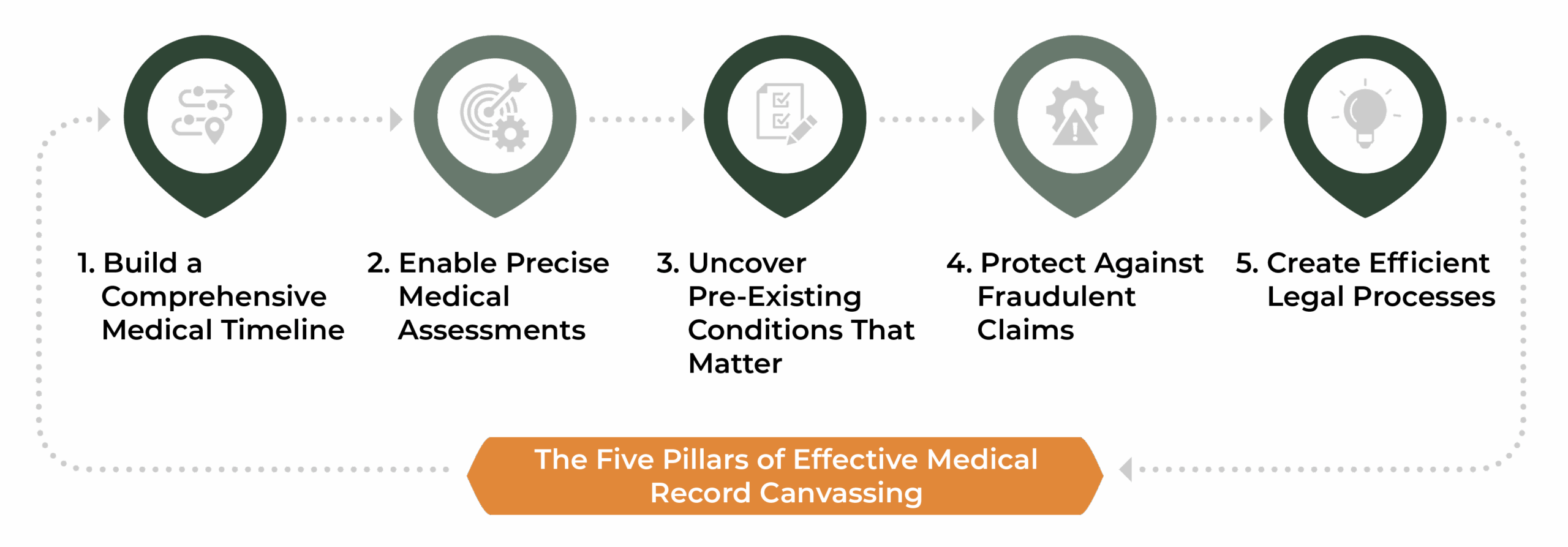
The Five Pillars of Effective Medical Record Canvassing
1. Build a Comprehensive Medical Timeline
Thorough medical record canvassing goes beyond collecting documents. Record canvassing creates a complete chronological picture of a claimant’s health journey. This comprehensive history serves multiple critical functions:
- For Legal Professionals: A complete timeline helps establish causation, identify potential liability issues, and develop stronger case strategies. When representing clients or defending claims, having the full picture prevents costly surprises during depositions or trial.
- For Insurance Adjusters: Understanding the complete medical background enables accurate reserve setting, appropriate settlement negotiations, and identification of subrogation opportunities.
- For Medical Professionals: Healthcare providers can make better treatment decisions when they understand the full scope of previous interventions, medications, and outcomes.
2. Enable Precise Medical Assessments
Incomplete medical histories lead to incomplete assessments. When healthcare providers and legal professionals have access to comprehensive records, several benefits emerge:
- Improved Treatment Outcomes: Physicians can identify patterns, avoid contraindicated treatments, and build upon previous successful interventions.
- Enhanced Expert Opinions: Medical experts providing litigation support can offer more credible and defensible opinions when working with complete records rather than partial information.
- Reduced Medical Complications: Understanding previous surgeries, allergic reactions, and treatment responses helps prevent adverse events and improves patient safety.
3. Uncover Pre-Existing Conditions That Matter
Perhaps no aspect of medical record canvassing is more critical than identifying pre-existing conditions. This isn’t about denying legitimate claims—it’s about accurate assessment and appropriate treatment:
- Causation Analysis: Determining whether current symptoms relate to a recent incident or represent progression of existing conditions requires complete historical data.
- Treatment Planning: Pre-existing conditions often influence treatment approaches, recovery timelines, and expected outcomes.
- Fair Claim Resolution: Both claimants and defendants benefit when claims are evaluated based on complete and accurate information rather than assumptions or partial data.
4. Protect Against Fraudulent Claims
While the vast majority of claims are legitimate, comprehensive record canvassing serves as an important safeguard against fraud:
- Identifying Inconsistencies: Discrepancies between reported symptoms and documented medical history can reveal potential fraud or at minimum, areas requiring additional investigation.
- Pattern Recognition: Multiple claims with similar fact patterns or symptoms may indicate organized fraud schemes.
- Documentation Verification: Comparing records across multiple providers can identify fabricated or altered medical documents.
- Timeline Verification: Ensuring reported injury dates align with actual treatment timelines helps verify claim authenticity.
5. Create Efficient Legal Processes
Complete medical records streamline every aspect of legal proceedings:
- Faster Case Resolution: When all parties have access to complete information from the beginning, cases resolve more quickly and efficiently.
- Reduced Discovery Disputes: Comprehensive upfront record collection minimizes expensive discovery battles over missing documents.
- Stronger Settlement Negotiations: Both sides can negotiate from positions of complete information, leading to more appropriate settlement values.
- Improved Trial Preparation: Complete records allow for thorough case preparation without last-minute surprises that can derail strategies.
The Technology Advantage in Modern Record Canvassing
Today’s medical record canvassing leverages advanced technology to achieve unprecedented thoroughness and efficiency. Database integration allows modern canvassing services to access multiple healthcare databases, insurance networks, and provider directories to identify potential sources of records that might otherwise be overlooked. Geographic expansion capabilities enable nationwide searches that can identify treatment across state lines and provider networks, ensuring no stone is left unturned regardless of where care was received.
Advanced algorithms provide sophisticated pattern recognition that can identify naming variations, address changes, and provider relationships that might be missed in manual searches. This technology-driven approach significantly reduces the likelihood of missing critical medical information due to variations in how names, addresses, or provider information is recorded across different systems.
Compliance management through automated systems ensures that record requests comply with HIPAA, state privacy laws, and court requirements, reducing legal risk while maintaining the integrity of the canvassing process. This technological infrastructure not only improves the comprehensiveness of medical record discovery but also streamlines the entire process, making it more efficient and reliable than traditional manual methods.
The ROI of Comprehensive Medical Record Canvassing
The financial benefits of thorough medical record canvassing extend far beyond the cost of the service. Reduced claim costs result from accurate assessment of pre-existing conditions, which can significantly reduce claim valuations when appropriate. Faster resolution becomes possible when complete information enables quicker decisions, reducing administrative costs and legal fees that accumulate during prolonged case timelines.
Improved outcomes emerge from better medical information that leads to more appropriate treatment plans and improved claimant outcomes, benefiting all parties involved. Risk mitigation occurs through early identification of potential issues in the claims process, preventing costly complications that can arise later in litigation or treatment. Enhanced credibility comes from complete documentation that strengthens your position in negotiations and litigation, providing a solid foundation for case strategy and settlement discussions.
Ready to ensure you have the complete picture? Contact ISG today to learn how our comprehensive medical record canvassing services can strengthen your claims process, improve outcomes, and reduce costs through the power of complete information.